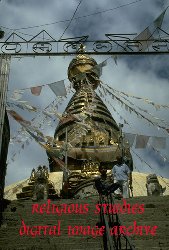
Founded by William Herbrechtsmeier, Professor of Religious Studies at Humboldt State University (where it is housed), and by Todd Lewis, Professor of Religion at The College of the Holy Cross (whose photos were the first posted), this Archive has created a resource of copyright-free digital images that are catalogued, annotated, and arranged in sets for use as a classroom resource for teachers of world religions. Supported in its start-up by grants from the American Academy of Religion, this archive is freely available to students, scholars, and the general public over the Internet for educational purposes. We are currently seeking funding to make this site a dynamic resource for those teaching the history of world religions.
Vision and Promise. One of the most important new areas for the dissemination of ideas in Religious Studies lies within the domain of digital technology and wide area computer networks. Increasingly on the World Wide Web (WWW), one finds resources for the study of religion that are freely available to anyone with access to the Internet. For teachers who have access to the internet, most of the information about religion currently available on the WWW is text based. Various forms of digital imagery are becoming more numerous, so that many who have traditionally used slides and video in the classroom are coming to see that digitized imaging offers advantages over more traditional technologies. As processor speeds, network throughput, and storage capacity increase, the ability of teachers and scholars in Religious Studies to communicate with images will become ever more central to the way we teach and present our research.
Among the most important obstacles to producing good quality multi-media materials that can be made available over a network are the copyright restrictions that are usually imposed on published images. Under the "fair use" clause of copyright law, many of us have made slides from books that we use in the classroom to illustrate important concepts in our classes. However, such images cannot legally be mounted on a networked server for use on campus by our students. Likewise, we have traditionally had difficulty publishing images along with our scholarly work, both because printing images is costly, and because acquiring the rights to publish already copyrighted images is time-consuming and/or expensive.
Digital imaging and networking holds the promise of changing all this. In the first place, it is now relatively inexpensive for educational institutions to mount digital images on a networked server, so that end users can have access to them free of charge. This has applications for instruction, since the slides which were at one time only available to students in the classroom, now can be made available over the campus network 24 hours a day in a hyper-media format (e.g., using HTML and Netscape) for orchestrated laboratory assignments or exams. Moreover, instructors can share effective images among themselves over the Internet, both for computer-generated visuals in the classroom (e.g. using Microsoft POWERPOINT) or for multi-media presentations among peers.
For access to many of the images that are most useful in our work as scholars and teachers, copyright restrictions need no longer be an issue. Among the thousands of scholars teaching religion, there are now in our personal libraries countless slides that are unencumbered by copyright. We have all seen our colleagues' photos of shrines, devotees, rituals, amulets, masks, and so forth, all of which are magnificent illustrations of the beauty and power of religion that so captivate us and inform our students. Many of the these images are of high quality, and we (as scholars) can vouch for and describe their ethnographic and historical authenticity. If these images were digitized, networked, and catalogued, they could immediately be made available for use by students and scholars all over the world. It is our intention in this project to gather a broad range of images and to re-distribute them to those who are interested in using them for educational and scholarly purposes. Our current thinking (2/99) is that we will develop the archive as a journal, soliciting thematic sets from contributors, whose annotation will allow users to download their slide-sets for use. Contact Todd Lewis or William Herbrechtsmeier for information on the most recent efforts to move the archive forward.