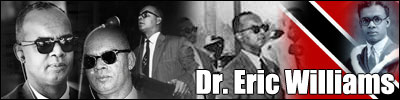
In an era when all thought and action was Euro-centered one brave man defied social norms and embarked on a philosophical journey of slavery, the slave trade system, and its beneficiaries. Born in Trinidad and Tobago on September 25, 1911, Eric Eustace Williams was destined to become a black idol that would later change social thought surrounding Caribbean slavery forever. Educated at Queen’s Royal College and later Oxford University, Dr. Williams excelled in academics at both institutions but delved deeply into Caribbean slavery and the slave trade at the latter. In 1938, Williams graduated with a First Class Honors degree in philosophy from Oxford University where he composed his doctoral thesis entitled, “Economic Aspects of the Abolition and Emancipation of Slavery in the British West Indies”.
Contradicting popular belief during this period,  Dr. William’s doctoral thesis brought African labor on the Caribbean Islands to the forefront of the British economic system. He essentially reversed all notions that the Caribbean islands were able to flourish due to European prosperity. Instead, Williams believed that Caribbean slavery was the basis of European economic growth which inevitably led to the industrial revolution. Dr. Williams also investigated the exploitation of Caribbean resources for the prosperity of the British. The irony that Dr. Williams observed, was that Caribbean resources and African labor were continuously being depleted which consequently invested innumerable amounts of wealth to the British yet neither the islands nor the Africans saw any substantial economic growth. These same Caribbean islands that were responsible for the increase of wealth are now some of the most underprivileged places in the world.
Invoking such a philosophy during this era garnered universal attention for Dr. Williams while simultaneously angering many British natives. Unable to receive occupation in Britain, Williams immigrated to the U.S. in 1939. He became Associate Professor at Howard University where he expanded his doctoral thesis titling it “The Economic Aspect of the West Indian Slave Trade and Slavery”.  Williams returned to Trinidad in 1948 where he continued his progressive thinking by petitioning for a Federation of the West Indies whose main purpose was to create political cohesion between the Caribbean islands. This federation would promote autonomy in nations throughout the Caribbean that were dependent on Britain while providing support for each other. In 1956, Dr. Williams founded the People’s National Movement (PNM) party which aided in the independence of Trinidad and Tobago in 1962. Dr. Williams held various political positions in the Trinidadian government including, Chief Minister, Premier and finally Prime Minister in 1962. Having lived an extensive life, conquering the odds and attaining achievements thought to be impossible for a black man in society, Dr. Eric Williams died in 1981 at the age of seventy while still in office. Despite his death, Dr. William’s legacy continues and he has definitely secured his position as a black idol in the African Diaspora.
Dr. Eric Williams' Independance Day Speech - August 31, 1962